
Introduction
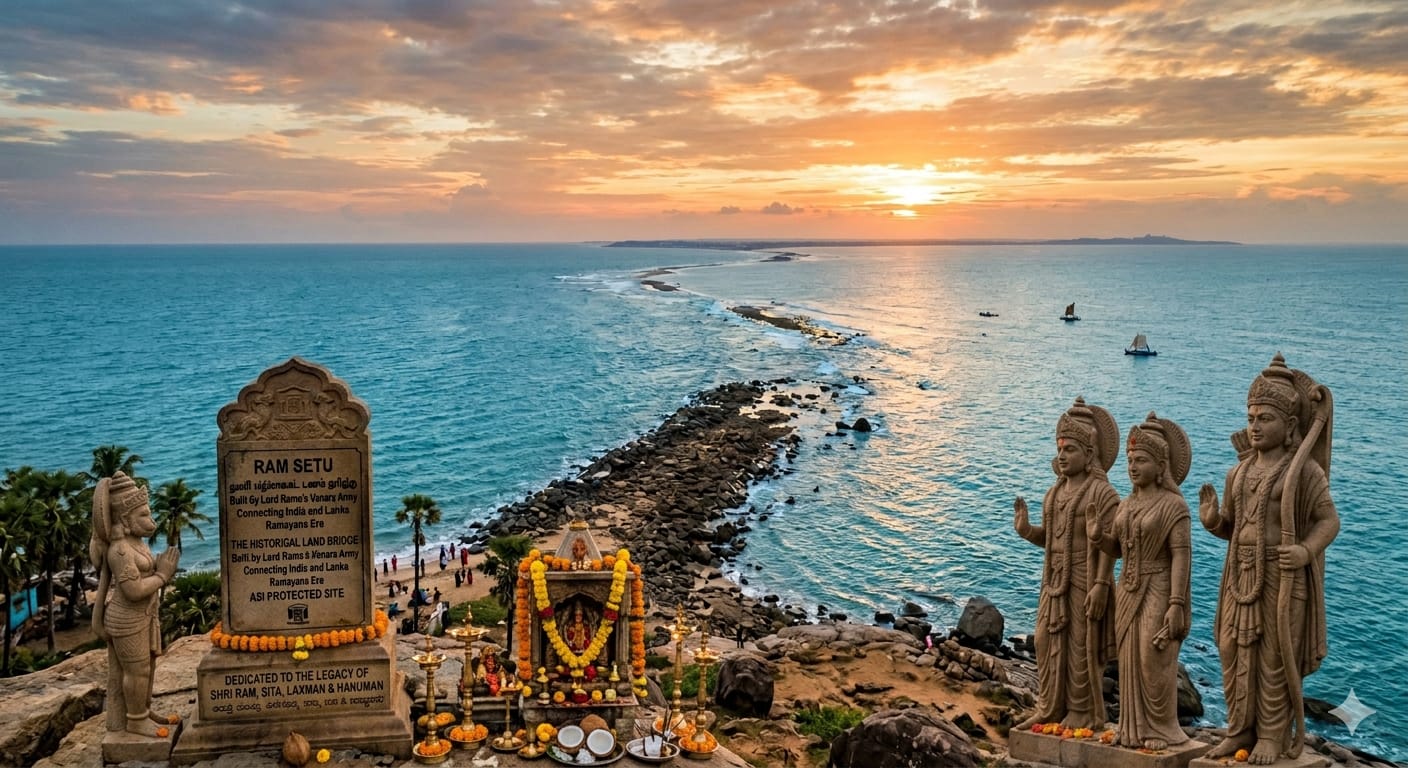
The story of Ram Setu, also known as Adam’s Bridge, has fascinated people for centuries. Mentioned in the ancient Indian epic the Ramayana, Ram Setu is believed to be the legendary bridge built by Lord Rama’s army to reach Lanka and rescue Goddess Sita from Ravana. Stretching between Rameswaram and Sri Lanka, this mysterious chain of limestone shoals continues to spark debates among historians, archaeologists, scientists, and spiritual believers.
The question “Is the Ramayana Bridge real?” has become one of the most discussed topics related to Indian mythology and ancient history. Some believe Ram Setu is undeniable evidence of events described in the Ramayana, while others view it as a naturally formed geological structure. Satellite images, ancient scriptures, historical records, and scientific studies have all contributed to the mystery surrounding this fascinating formation.
In this article, we explore the history, mythology, scientific perspective, religious significance, and ongoing debate surrounding Ram Setu to understand whether the Ramayana Bridge is myth, history, or a combination of both.
What is Ram Setu?
Ram Setu is a chain of limestone shoals located in the shallow waters between India and Sri Lanka. The structure stretches across the Palk Strait and connects the island of Rameswaram in Tamil Nadu to Mannar Island in Sri Lanka.
The bridge-like formation is approximately 48 kilometers long and can even be seen from satellite imagery. Because of its unusual appearance, many people associate it with the bridge described in the Ramayana.
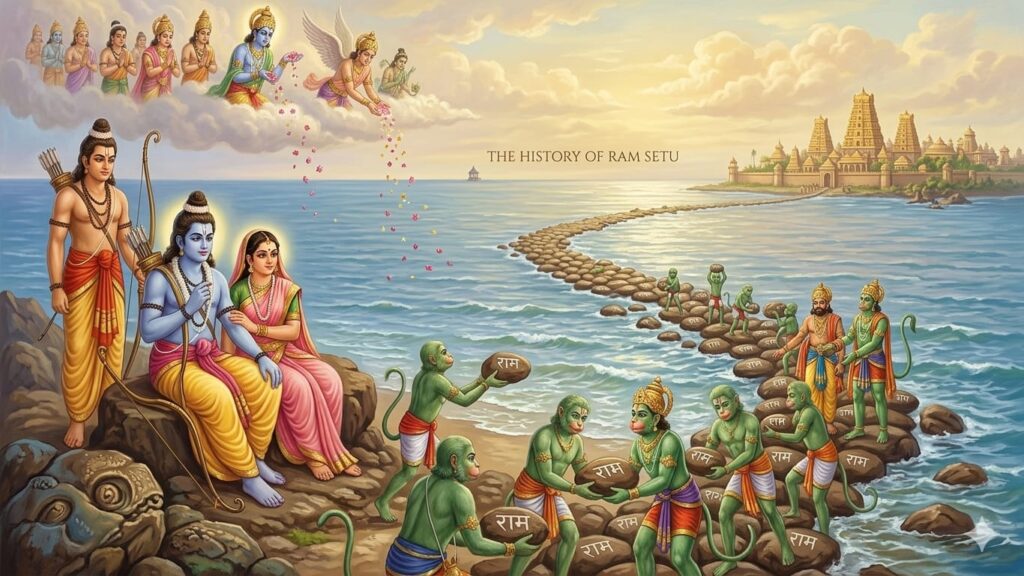
In Hindu tradition, Ram Setu is considered sacred because it is believed to have been constructed by Lord Rama and his Vanara army led by Hanuman.
Ram Setu in the Ramayana
The Ramayana, written by the sage Valmiki, narrates the story of Lord Rama’s journey to rescue Sita from Ravana, the king of Lanka.
According to the epic:
- Ravana kidnapped Sita and took her to Lanka.
- Lord Rama, along with Lakshmana and Hanuman, traveled south in search of her.
- To cross the ocean and reach Lanka, Rama’s army built a bridge across the sea.
- The bridge was constructed using floating stones inscribed with Lord Rama’s name.
- The bridge allowed Rama’s army to march into Lanka and defeat Ravana.
For millions of Hindus, Ram Setu is not just a geographical structure—it is a symbol of faith, devotion, courage, and divine power.
Is the Ramayana Bridge Real?
The question of whether Ram Setu is real depends on how people interpret mythology, science, and history.
Religious Perspective
From a spiritual viewpoint, many Hindus strongly believe Ram Setu is the actual bridge built by Lord Rama’s army thousands of years ago.
Religious texts, temple traditions, and local folklore continue to support this belief. Pilgrims visiting Rameswaram often consider the site sacred and closely connected with the events of the Ramayana.
For believers, Ram Setu represents:
- Divine intervention
- Ancient Indian civilization
- Faith and devotion
Scientific Perspective
Scientists generally describe Ram Setu as a naturally formed chain of sandbanks and limestone shoals created through geological processes.
Studies suggest:
- The formation developed naturally over thousands of years.
- Coral reefs, sand deposits, and sedimentation contributed to its structure.
- Changes in sea level and coastal movement shaped the formation gradually.
However, the unusual linear arrangement of the structure has led some researchers to question whether human activity may have influenced it at some point in history.
NASA Images and the Ram Setu Debate
The mystery surrounding Ram Setu became even more popular after satellite images of the bridge-like formation were circulated widely on the internet.
Many people claimed that NASA had “proved” the existence of the Ramayana bridge. However, NASA clarified that the images only showed a natural formation between India and Sri Lanka and did not confirm any mythological claims.
Still, the satellite images sparked worldwide curiosity because the structure closely resembles a man-made pathway across the sea.
This debate continues today, with believers and skeptics interpreting the evidence differently.
Historical References to Ram Setu
Ram Setu has been mentioned in several ancient texts and historical records over centuries.
Some references include:
- Ancient Hindu scriptures
- Tamil literature
- Religious travel accounts
- Historical maps
In earlier times, parts of the bridge were believed to be above sea level, allowing people to walk across shallow areas between India and Sri Lanka.
Some historians suggest that the structure may have served as a natural land connection in ancient times before rising sea levels submerged parts of it.
Geological Formation of Ram Setu
Geologists describe Ram Setu as a chain of:
- Sandbanks
- Limestone shoals
- Coral formations
- Sedimentary deposits
The shallow waters of the Palk Strait created ideal conditions for these formations over long periods.
Some scientists believe the bridge-like appearance is a result of:
- Ocean currents
- Coral growth
- Sediment accumulation
- Coastal geological activity
Despite scientific explanations, the symmetrical and connected appearance of Ram Setu continues to intrigue researchers and believers alike.
Religious Importance of Ram Setu
For Hindus, Ram Setu holds immense spiritual significance.
It is closely associated with:
- Lord Rama’s victory over evil
- Devotion and righteousness
- The sacred journey described in the Ramayana
Pilgrims visiting Rameswaram often perform rituals connected to Lord Rama before visiting nearby sacred sites.
Many devotees believe that preserving Ram Setu is important for protecting India’s spiritual and cultural heritage.
Why Ram Setu Remains a Mystery
Ram Setu continues to remain mysterious because both mythology and science offer compelling perspectives.
Reasons Behind the Mystery:
- Ancient epic references
- Unusual bridge-like formation
- Satellite imagery
- Historical accounts
- Religious significance
- Geological uniqueness
The combination of faith, science, and history makes Ram Setu one of the most fascinating topics in Indian culture.
Ram Setu and Indian Culture
Ram Setu is deeply connected with Indian identity and heritage.
The bridge symbolizes:
- Faith and devotion
- Ancient traditions
- Cultural pride
- Spiritual history
Stories of Lord Rama and Ram Setu are shared through:
- Festivals
- Religious plays
- Temples
- Literature
- Television and films
Its influence extends far beyond mythology and continues to inspire millions worldwide.
Environmental and Political Discussions
Ram Setu has also become part of environmental and political discussions in India.
The proposed Sethusamudram Shipping Canal Project sparked controversy because it involved dredging parts of the Ram Setu area.
Opponents argued that:
- Ram Setu is sacred heritage.
- The structure should be preserved.
- The project could damage marine ecosystems.
Supporters believed the project would improve maritime trade routes.
The debate highlighted the balance between development, environmental protection, and cultural preservation.
Could Ancient Engineering Have Been Possible?
Some researchers and historians speculate that ancient civilizations may have modified naturally existing formations.
Ancient India had remarkable engineering achievements, including:
- Stepwells
- Temple architecture
- Water management systems
- Stone construction techniques
This has led some people to wonder whether Ram Setu could have involved human intervention built upon a natural base.
However, no universally accepted archaeological evidence currently proves this theory conclusively.
Tourism and Ram Setu
Ram Setu attracts tourists, pilgrims, researchers, and spiritual travelers from around the world.
Popular nearby attractions include:
- Rameswaram Temple
- Dhanushkodi
- Pamban Bridge
- Sacred coastal sites
Visitors are drawn by:
- Religious significance
- Historical curiosity
- Scenic beauty
- Mythological fascination
The region continues to remain one of India’s important spiritual tourism destinations.
The Blend of Mythology and History
One reason Ram Setu fascinates people so deeply is because it exists at the intersection of mythology and physical geography.
Unlike fictional places that exist only in stories, Ram Setu is a real visible formation connected with an ancient epic still followed by millions.
This blend of:
- Sacred storytelling
- Real-world geography
- Cultural belief
- Scientific inquiry
creates endless fascination around the Ramayana bridge.
Conclusion
The question “Is the Ramayana Bridge real?” may never have a single universally accepted answer. For believers, Ram Setu is undeniable proof of the events described in the Ramayana and a sacred symbol of devotion and divine power. For scientists, it remains a naturally formed geological structure shaped over thousands of years.
Regardless of differing opinions, Ram Setu continues to hold immense cultural, historical, and spiritual significance. Its mysterious appearance, ancient references, and connection to one of the world’s greatest epics ensure that it remains a subject of curiosity and reverence.
Whether viewed through the lens of faith, science, or history, Ram Setu stands as one of the most fascinating landmarks associated with Indian civilization. It reminds us how mythology, geography, and human imagination can come together to create stories that continue inspiring generations across the world.